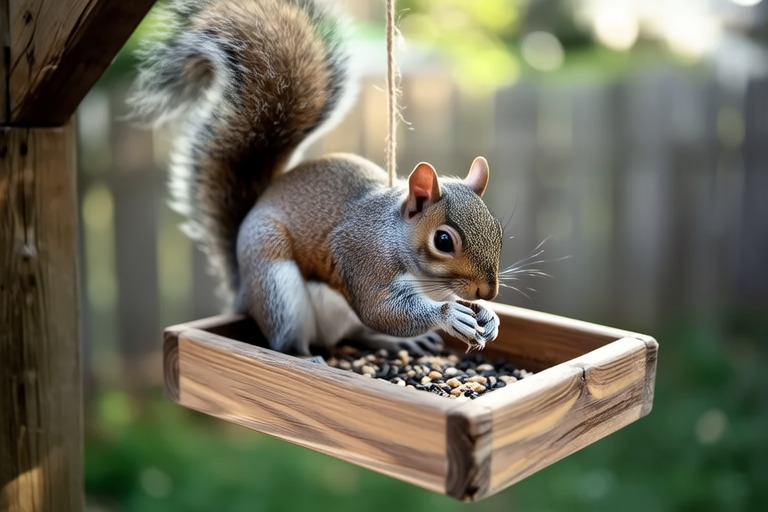
5 Ingenious Ways Squirrels Outsmart Backyard Feeders
In backyards across North America, bird feeders are a common sight. They provide a convenient source of food for birds, but they also attract another clever creature: the squirrel. Known for their agility, problem-solving skills, and relentless pursuit of snacks, squirrels have developed a variety of methods to outwit even the most secure bird feeders. This article delves into five ingenious ways squirrels manage to access bird feeders, offering unique insights into their behavior, strategies, and the sometimes humorous interactions that occur between these animals and their human observers.
1. Acrobatic Feats: The Art of Balance
Squirrels are natural acrobats, capable of scaling vertical surfaces with ease. Their sharp claws and strong hind legs make them adept at climbing trees, fences, and other obstacles to reach bird feeders. One of the most impressive techniques they use is balancing on thin branches or wires leading up to feeders. Scientists have observed that squirrels can maintain their balance by adjusting their posture and gripping with both forepaws and hind paws simultaneously.
A classic example of this acrobatic prowess involves a feeder hanging from a single wire. The squirrel approaches the wire, carefully gauging its distance and stability. It then leaps onto the wire, using its tail for balance, and proceeds to climb upward. Once it reaches the feeder, it often pauses to survey the area before indulging in the seeds. This cautious approach ensures the squirrel’s safety and maximizes its chances of a successful snack.
One amusing anecdote comes from a homeowner who installed a bird feeder high on a metal pole, thinking it would be squirrel-proof. To everyone’s surprise, a determined squirrel managed to wrap its body around the pole, using its tail as an anchor, and climbed right up to the feeder. The homeowner was left both impressed and slightly frustrated by the squirrel’s ingenuity.
2. Teamwork: The Power of Collaboration
While squirrels are often seen as solitary creatures, they occasionally work together to access bird feeders. This cooperative behavior is particularly evident when dealing with complex setups that require multiple steps to bypass. For instance, one squirrel might distract the homeowner or other potential threats while another squirrel climbs the feeder. Once the first squirrel has secured the feeder, it may signal to its partner, allowing both to feast together.
Observations show that squirrels can communicate through vocalizations and body language. A series of chirps or barks can alert others to the presence of food, while tail flicks or head movements can signal danger. In a study conducted in a suburban park, researchers noticed that squirrels working together were more successful in accessing feeders compared to those acting alone.
One memorable instance involved a family of squirrels that had discovered a feeder hidden behind a bush. The mother squirrel would stand guard at the entrance, ensuring no predators approached, while her offspring took turns climbing the feeder and retrieving seeds. The family worked seamlessly, demonstrating the importance of teamwork in overcoming challenges.
3. Stealth Mode: The Art of Subterfuge
Squirrels are masters of stealth, capable of approaching bird feeders without being detected. They use various tactics to remain undetected, such as moving slowly and deliberately, blending in with their surroundings, and taking advantage of cover. These stealthy maneuvers allow them to avoid confrontations with larger animals or humans who might try to deter them.
One effective strategy involves squirrels crawling along the ground beneath bushes or shrubs until they reach the base of the feeder. From there, they can quickly ascend the pole or branch, minimizing the risk of detection. Another technique is to wait until dusk or dawn when visibility is low and human activity decreases. During these times, squirrels can move freely and access feeders without interference.
Humorously, one homeowner reported watching a squirrel approach a feeder under the cover of darkness. As the squirrel neared the feeder, it paused and peeked around a corner, much like a spy checking for guards. After confirming the coast was clear, the squirrel darted forward and climbed the feeder in a matter of seconds. The homeowner found this display of caution and speed both endearing and frustrating.
4. Problem-Solving Skills: The Puzzle Masters
Squirrels are renowned for their problem-solving abilities. When faced with a challenging feeder, they will often spend time observing and experimenting with different methods to access the food inside. This trial-and-error process demonstrates their intelligence and adaptability. Scientists have documented numerous instances where squirrels have successfully solved puzzles to obtain treats.
For example, a study involving a puzzle feeder designed to test cognitive abilities showed that squirrels could figure out how to open the mechanism within minutes. The feeder required the squirrel to pull on a string to release the food, and many subjects managed to solve the puzzle on their first attempt. This level of quick thinking and persistence is remarkable for an animal often considered simple-minded.
An entertaining story involves a squirrel that encountered a new type of feeder featuring a rotating platform. Initially puzzled, the squirrel spent several days trying various approaches, including jumping and clawing at the platform. Eventually, it figured out that by standing on the edge of the platform and shifting its weight, it could rotate the entire feeder and access the seeds. The homeowner was amazed by the squirrel’s determination and cleverness.
5. Persistence: The Never-Give-Up Attitude
Persistence is perhaps the most defining trait of squirrels when it comes to accessing bird feeders. No matter how many obstacles they face, squirrels rarely give up. They will continue to try different methods until they succeed. This tenacity is what makes them so formidable opponents for backyard enthusiasts attempting to keep them away from feeders.
One homeowner shared a story about a squirrel that repeatedly attempted to climb a feeder mounted on a metal pole. Despite the difficulty of the climb, the squirrel persisted, trying day after day. Eventually, it managed to scale the pole and access the feeder. The homeowner was left in awe of the squirrel’s perseverance.
Another example of this persistence came from a community garden where a squirrel was determined to reach a feeder placed high above the ground. Over several weeks, the squirrel tried various methods, including building makeshift ladders from sticks and leaves. Finally, it succeeded by creating a sturdy structure that allowed it to reach the feeder. The effort and dedication displayed by the squirrel were truly inspiring.
Conclusion
Squirrels are fascinating creatures with remarkable abilities that allow them to outsmart even the most secure bird feeders. Through acrobatics, teamwork, stealth, problem-solving, and persistence, they demonstrate their intelligence and adaptability. While homeowners may find these antics frustrating, they also offer a glimpse into the complex world of wildlife and the intricate relationships within backyard ecosystems.
Next time you see a squirrel in your yard, take a moment to appreciate its cleverness and resilience. Who knows? You might even find yourself smiling at the latest trick it has up its sleeve.
