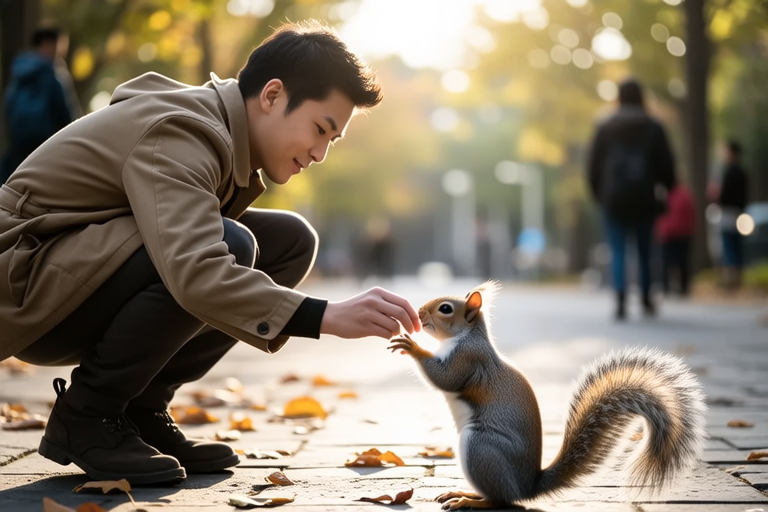
Adventures in Feathers and Fur: One Man’s Journey Raising an Urban Squirrel
It was a crisp autumn afternoon when I first encountered him—a tiny, trembling bundle of fur nestled among the leaves of a city park. His eyes were wide with fear, his small paws scrabbling against the rough bark of a tree. I knew immediately that he needed help. Little did I know that my decision to rescue this baby squirrel would lead me on an extraordinary journey, one that would intertwine my life with the mysteries of urban wildlife.
The Rescue
Rescuing the squirrel was straightforward; the real challenge began once I brought him home. My apartment, a cozy haven in the heart of the city, suddenly felt too small. The little creature, whom I named Finn, required constant attention and care. He needed a warm, quiet space to rest, and I quickly set up a makeshift nest in a corner of my living room, lined with soft towels and blankets. Finn was fragile, his tiny body still adjusting to life outside the nest. I made sure to keep him warm with a heating pad and monitored his temperature regularly.
Dietary Needs
Finn’s diet was another crucial aspect of his care. Baby squirrels require a high-protein diet to grow strong and healthy. Initially, I fed him a specialized formula designed for orphaned mammals. However, as he grew older, I gradually introduced solid foods, starting with finely chopped nuts and fruits. Watching him nibble on these treats was both amusing and endearing. His dainty paws would grasp at the food, and he would stuff it into his mouth with surprising efficiency. I also learned that squirrels need a balanced diet rich in fats and proteins, which are essential for their energy and growth. This meant carefully selecting a variety of nuts, seeds, and fruits to ensure he received all the nutrients he needed.
Behavior and Interaction
Observing Finn’s behavior was one of the most fascinating aspects of our relationship. He was curious by nature, always exploring his surroundings with a keen sense of adventure. In the early days, he would climb up the curtains or scurry across the floor, his movements quick and agile. As he grew more comfortable in his new environment, he became more social. He enjoyed playing with small toys, such as balls and wooden blocks, and would often follow me around the apartment, occasionally pausing to watch me with intense interest.
One of the most memorable moments came when Finn discovered the window sill. He would sit there for hours, gazing out at the bustling city life below. The sight of cars whizzing by, people walking their dogs, and birds flying overhead captivated him. It was a stark contrast to the natural environment he had been born into, and it was clear that he was adapting to his new urban setting.
Challenges of Urban Wildlife Rehabilitation
Raising Finn was not without its challenges. One of the biggest obstacles was ensuring his safety in an urban environment. While he was growing stronger, he still lacked the instincts necessary to navigate the dangers of city life. Cars, predators, and human interference were constant threats. To protect him, I took extra precautions, keeping him indoors during the day and only allowing supervised outdoor time in enclosed spaces. Even then, there were close calls. Once, while exploring a small garden, he darted after a butterfly and almost ran into the street. It was a terrifying moment, but Finn managed to stop just in time, thanks to my quick reflexes.
Another challenge was the emotional toll of preparing Finn for release back into the wild. As much as I had grown attached to him, I knew that his true home was not in my apartment. The thought of letting him go was bittersweet, but I understood that it was for his own good. I worked closely with local wildlife rehabilitators to ensure that Finn was ready for release. They provided guidance on how to acclimate him to the outdoors and taught me how to create a safe transition environment.
The Emotional Connection
Despite the challenges, the bond between Finn and me was undeniable. There were moments of deep connection, where we would sit together in silence, sharing a quiet understanding. I remember one evening when I was feeling particularly down, and Finn seemed to sense my mood. He climbed onto my lap and curled up next to me, his small body seeking comfort. It was a simple gesture, but it filled me with warmth and reminded me of the profound impact that even the smallest creatures can have on our lives.
As Finn grew older, his independence became more apparent. He spent less time with me and more time exploring his surroundings. It was a gradual process, and I found myself both proud and sad. Proud because he was thriving, and sad because I knew that our time together was coming to an end. But I also knew that releasing him was the right thing to do. It was a bittersweet moment when the day finally arrived. With tears in my eyes, I watched as Finn scampered off into the trees, his tail flicking behind him. It was a moment of both joy and sorrow, a reminder of the beauty and fragility of life.
Reflections
Reflecting on my journey with Finn, I realize that this experience has profoundly impacted both me and the community. For me, it was a humbling reminder of the interconnectedness of all living beings. It taught me patience, responsibility, and the importance of empathy. Caring for Finn was not just about providing food and shelter; it was about understanding his needs, respecting his boundaries, and nurturing his spirit. It was a privilege to be a part of his life, even if only for a short time.
On a broader scale, my experience with Finn has sparked conversations within the community about the importance of coexisting with urban wildlife. Many people have expressed interest in learning more about wildlife rehabilitation and how they can contribute to protecting these animals. This has led to the formation of local groups dedicated to supporting urban wildlife, and there has been a noticeable increase in awareness and action. People are more willing to report injured animals, donate supplies, and participate in educational programs. It is heartening to see the positive change that can come from one person’s experience.
In conclusion, my adventures with Finn have been a transformative journey. They have taught me valuable lessons about responsibility, compassion, and the delicate balance of life. Through Finn, I have gained a deeper appreciation for the natural world and the resilience of its inhabitants. And while saying goodbye was difficult, I take solace in knowing that I played a small role in helping him find his place in the world. It is a legacy that continues to inspire me and those around me.
